 |
|
Welcome Collectors!! Royal Albert China - Reference Website |
Search Google for Royal Albert China
|
Old Country Roses Pages

This Guide will provide a seller or buyer with enough information to determine that the Old Country Roses china pattern or piece in question is genuine, correctly described and from approximately when it was manufactured.
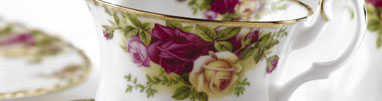
This range of English bone china tableware from Royal Albert is renowned the world over, with more than 100 million pieces produced and sold. The Harold Holdcroft inspired Old Country Roses (OCR) was launched in 1962. Originally planned to be called Treasure Garden, Harold Holdcroft MSIA FRSA NRD, Royal Albert's Art Director, based his design on the 1921 pattern King's Ransom
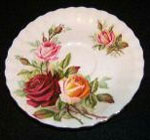 King's Ransom |
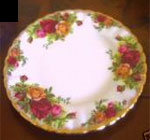 Old Country Roses |
The design was a result of years of work by Harold Holdcroft who said; We decided to incorporate all the ingredients we knew would be acceptable, richness of colour, softness of colour, good quality and a good value look. All these qualities are incorporated in the pattern. It has lush deep red roses, warmth from the tea roses, delicacy from the bluish pink and an overall softening off of the pattern by using a shade of soft warm green. The rich gold stipple trim gives the sprays continuity and the china good value for money.
Enhanced by the elegant traditional Royal Albert Montrose shape and the attractive scalloped edges finished in 22k gold, from the twist and curl of the teacup handles to the fluted trim on the teapot lid....the attention to detail has contributed to a superb original design.
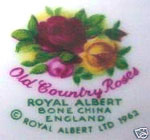
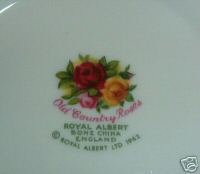
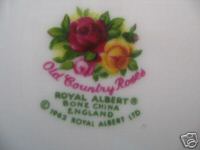
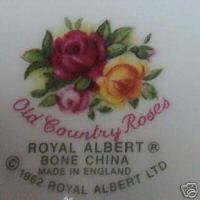
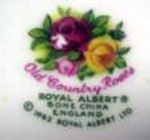
Where size allowed, all English produced backstamps consisted of :
Floral Spray.... 3 roses - red, yellow and pink against a green leaf background
Pattern Name.... Old Country Roses in red
Trade Name..... ROYAL ALBERT or ROYAL ALBERT (r)
Type of China... BONE CHINA
Country of Manufacture... ENGLAND or MADE IN ENGLAND
Copyright... (c) ROYAL ALBERT LTD 1962 or (c) 1962 ROYAL ALBERT LTD
as shown below
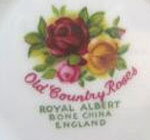 This is the original 1962 - 1973 |
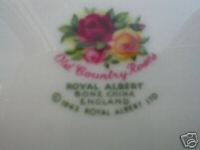
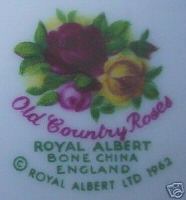
 1973 - 1993 (c) ROYAL |
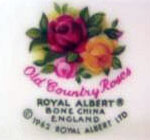
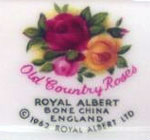 1973-1993 (c) 1962 |
 1993 - 2002 ROYAL ALBERT (R) |
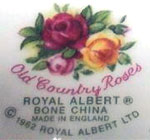 1993 - 2002 ROYAL ALBERT (R) MADE IN ENGLAND |
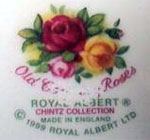
After checking literally thousands of listings, these five backstamps seem to be the only English manufactured range. The first four were used for tableware and the fifth for specialty and gift items. There is an additional backstamp which mentions "ENGLAND" but also says "MADE UNDER LICENCE" and it is strongly suspected that it would be in Asia, not another company in England.
Maybe in the future, a more standard description of these backstamps could be for example:
Original, C-Royal 1962, C-1962 Royal, CR-1962 Royal and CRM-1962 Royal
or Original, C-ROYAL, C-1962, CR-1962, and CRM-1962
My personal opinion is that the original 1962 -1973 backstamp pieces should be considered the most valuable as compared to the others. Harold Holdcroft was still working at Royal Albert at this time until he retired in late 1972. My logical reason is that his attention to detail would have ensured a high quality standard and co-operation with the production team. My sentimental reason is that this was the period when this extraordinary ceramic designer was still actively working with the company. ( this paragraph added May 19, 2010. )
My latest thoughts as of July 12, 2010 - are that the backstamps could be divided into five groups -
Group 1 - 1962-1972 Original
Group 2 - 1973-1993 Bottom Line : Copyright Royal Albert Ltd 1962
Group 3 - 1973 -1993 Bottom Line: Copyright 1962 Royal Albert Ltd
Group 4 - 1993 - 2002 Top Line : Royal AlbertCopyright Registered Bottom Line: Copyright 1962 Royal Albert Ltd
Group 5 - 1993 - 2002 Made in England
I think this best explains the four production periods and shows that the only difference from the original period was to either the top or bottom line and then the specialties had "Made in England" instead of just England. All pieces were made by the same production process and look the same unless you turn them over and look at the backstamp underneath.
Please note the difference between these two English produced backstamps is in the Copyright wording...
the last line of the backstamp starts (c) ROYAL or (c) 1962
It is not known at this stage which came first, however because both use the name ROYAL ALBERT without the (r) registration mark, we can safely assume it was after 1973 and before 1993 which was the year ROYAL ALBERT was registered as a trade mark.
The company of TC Wild & Sons Ltd was renamed Royal Albert Ltd in 1970, but ownership did not change until July 1972. It could be possible that the (c) ROYAL was used in that time and the (c) 1962 was used by the new owners Royal Doulton from July 1972 onwards.
More research in the near future will confirm this.
 |
 |
 |
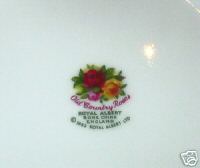 |
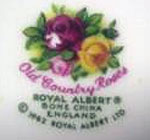
The major difference from other English backstamps is the (R) trade mark registration character located after ROYAL ALBERT.
The trade mark ROYAL ALBERT was registered in 1993, which was also the year that Royal Doulton demerged from the Pearson Group and listed publicly in their own right on the London Stock Exchange.
This period of some ten years represents the last of the English produced china in the district of Stoke-on-Trent, Staffordshire England.
 |
 |
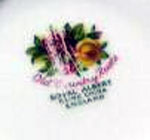
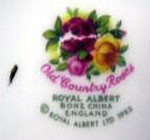
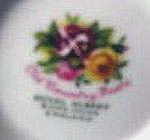
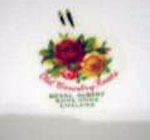
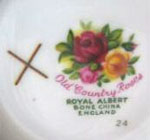
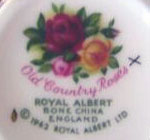
Whenever a product was too good to discard but not good enough to meet the factory's first quality standard, the backstamp was scratched or marked and then either given to staff or sold in staff or retail stores at a discounted price, usually 50% or even more.
The method of marking the underside to indicate a second was varied. It would have depended on what stage the flaw was discovered. The backstamp transfer could be partially cut or pinholed. Common flaws of seconds were; mis-alignment of graphic transfer, size variation, glazing or gilding flaw, a minor impurity or firing pitting, colour variation etc. Please note that gilders often put a test mark on the back/bottom....it does not indicate a flaw, it was simply used to test the gilding or sometimes to identify the production team.
Do not believe a claim that a second quality is as good as a first quality, the seller is just admitting that they cannot see the flaw. The item became a second for a specific reason. It may have been minor but it was enough for the manufacturer not to risk their reputation. You would be surprised just how many seconds were manufactured of this pattern.
Don't be afraid to ask questions such as...
Can you explain in more detail why you have described this item as mint condition and what is your return policy if we do not agree with your claim?
Is this an actual photo of the item and it's backstamp?
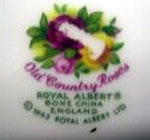
 This second has been scratched on the red rose to indicate it is a second |
 |
 |
 |
 |
 |
 |
 |
 |
 |
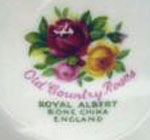 |
A factory second is exactly that...
It is an item that was rejected by the factory's quality control staff as unsuitable for first quality specification and sale.
It could have been a glazing flaw, mis-alignment of one of the graphic transfers, a colour variation, a firing or gilding flaw, variation in size, placement of handle...the list could go on. Please note that gilders often put a test mark on the back/bottom....it does not indicate a flaw, it was simply used to test the gilding or sometimes to identify the production team.
Just remember, no matter what anyone claims, the second was rejected for a specific reason, if the seller can't tell you what it is, it just means that they can't find it....not that it's not there....
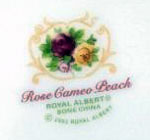
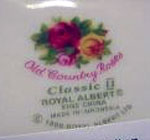
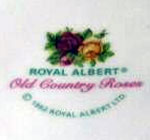
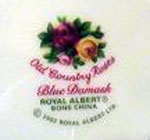
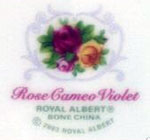
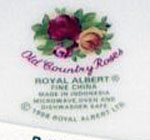
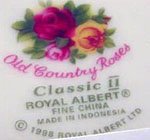
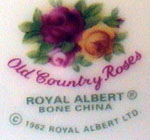
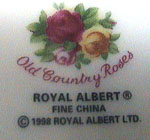
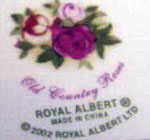
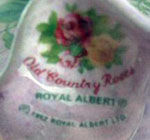
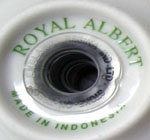
Production in Asia started as early as 1998 and by December 20, 2002. most of Royal Albert's production including Old Country Roses, was transferred to Indonesia, and some to China. Indonesian backstamps are mainly detectable by the absence of the word ENGLAND. Apart from that, they look the same as the English one to the untrained or unwary eye.
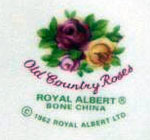 This is Indonesian |
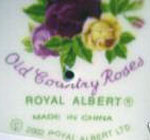 This is Chinese |
Notice that just the word "England" is missing |
"Bone China" is replaced with "Made in China" |
The four most common mistakes people make when buying Old Country Roses;
-
Buying Indonesian or Chinese OCR and thinking it is English
-
Buying 1962 backstamps in the belief that it is the year of manufacture
-
Buying factory seconds thinking they are first quality
-
Not checking descriptions for accurate condition of produc
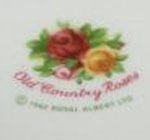 |
 |
 |
 |
 |
 |
 |
 |
 |
 |
 |
 |
 |
 |
 |
 |
 |
 |
 |
 |
 |
 |
 |
 |
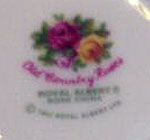 |
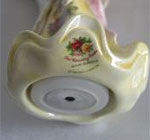
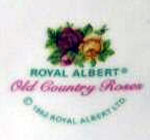
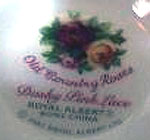
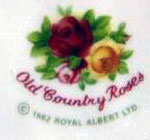
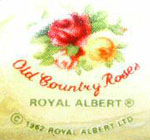
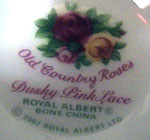
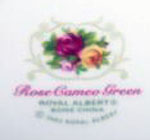
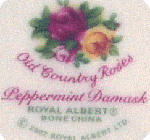
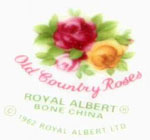
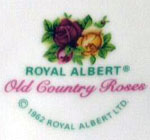
As you look at the various photos on this page, you will notice that most of the Asian backstamps look very similar to the English backstamps and so to the unwary eye, it is easy to make a mistake.
Most important of all is that whenever you do not see the word ENGLAND on a backstamp, you can be sure the item is Asian and most likely INDONESIAN.
According to various sources, Royal Doulton announced on December 20, 2002 that all Old Country Roses production would be transferred to their joint factory , distribution and marketing venture with the Multifortuna Group in Indonesia.
This is not entirely accurate as there are backstamps for product made in China with a 2003 copyright marking which proves that some production was transferred to China. Whether the Chinese factory is part of the Multifortuna Group is not yet confirmed. The copyright years found on asian produced OCR are 1962, 1998, 1999, 2002, 2003, 2004.
And of course, Royal Doulton was taken over by Waterford Wedgwood in January 2005. This is the sixth owner in the 44 years existance of Old Country Roses.
Particularly if you are looking for English produced OCR....make sure you check the backstamp carefully, many sellers do not think it important to mention the origin of manufacture in their description and so it is very often not in the description
Old Country Roses Pages |
|
||||
 |
 |
 |
 |
 |
 |
 |
 |
 |
 |
 |
 |
 |
 |
 |
 |
 |
 |
 |
 |
||||
Other Pages where you can find Old Country Roses
|
|||||
 |
 |
 |
 |
 |
 |
 |
 |
 |
 |
 |
 |